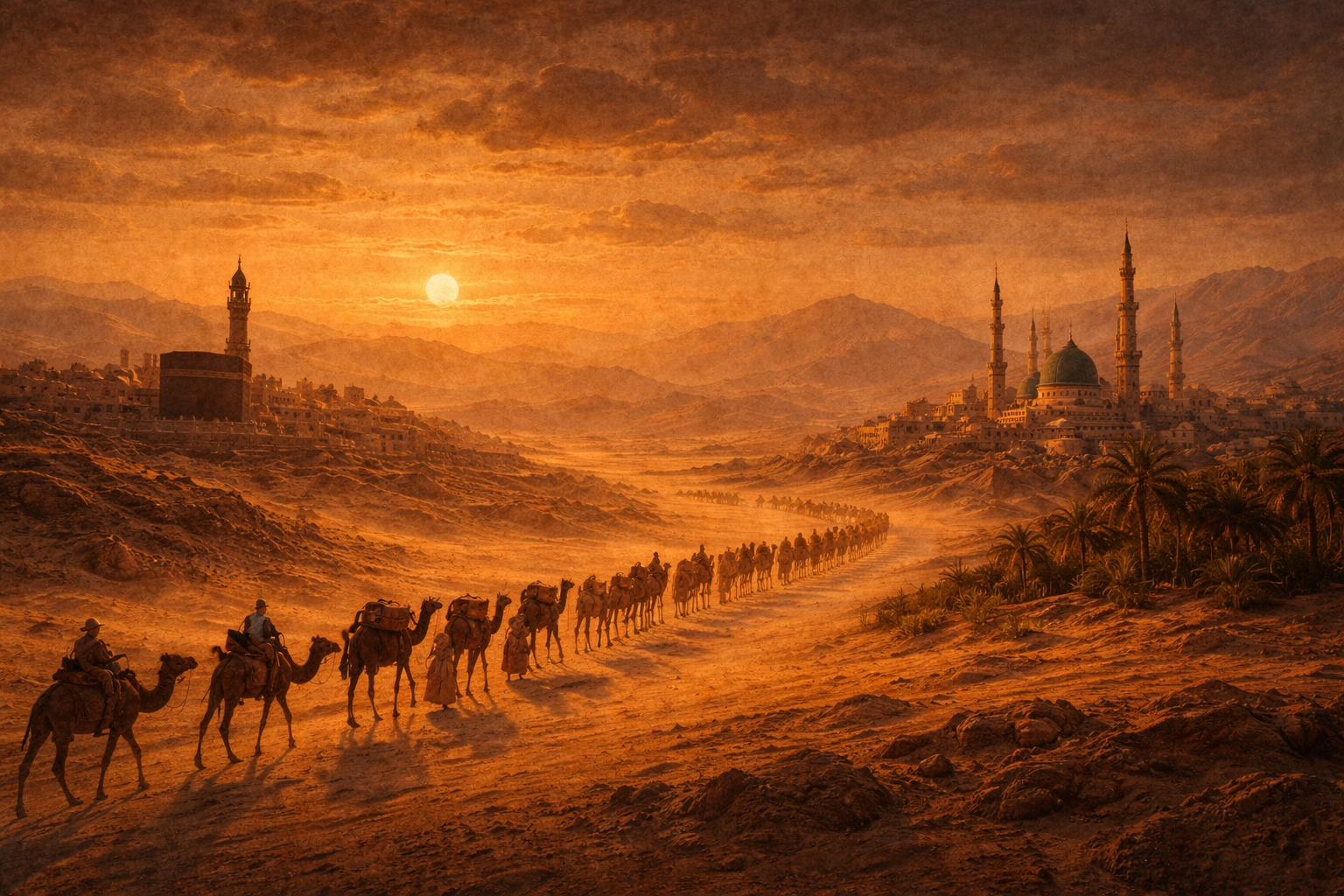
Not Just the Story of a Life but the Anatomy of a Civilisation.

Deeper SeerahMakkah AwakeningMadinan Flourishing is a rigorous and spiritually grounded exploration of the life of the Prophet ﷺ, examining the Sociological, Anthropological, Linguistic, Archaeological, and Psychological Forces that shaped the Prophetic era.

One Hundred Hours of Content and Counting!

Sample Videos

Ustadh Ahmir Nawaz

Your Instructor

Ustadh Ahmir Nawaz is a historian, traveller, poet and writer devoted to the study and teaching of the Seerah of the blessed Prophet Muhammad ﷺ.

Credentials

He holds a BA in history and ijāzahs (formal authorisations) in Seerah, Fiqh, ʿAqīdah, and Taṣawwuf, rooted in established scholarly chains of learning.

Specialisation

He specialises in teaching the Seerah through a deep analytical lens developed through many years of teaching across diverse formats, serving an international student base.

Experience

He has extensive teaching experience delivering Seerah to students from various cultural and academic backgrounds through structured courses, seminars, and collective book readings.

Why Deeper Seerah?

Most Seerah courses begin in Makkah. This one begins with the dawn of civilisation. In Deeper Seerah, we trace the story of the Prophet ﷺ through the great rivers of human history, drawing on anthropology, sociology, archaeology, linguistics, and classical history. We journey back to the Sumerians, Akkadians, Babylonians, and the earliest Arabian tribes, uncovering how ancient cultures, trade routes, belief systems, and shifting empires shaped the world into which the Prophet ﷺ was born. This approach reveals the Seerah not merely as a biography, but as the culmination of humanity’s long search for truth, set within a tapestry of civilizations that rose and fell long before Quraysh ever existed. It is Seerah with depth, context, and centuries of meaning, allowing every student to understand why revelation arrived precisely when, and where, it did.

Critical Analysis

Because this Seerah fuses the ancillary sciences into the heart of the narrative, treating them not as side notes, but as essential tools for understanding revelation. In Deeper Seerah, anthropology, archaeology, sociology, linguistics, and classical historiography stand shoulder-to-shoulder with the traditional sources. They are lenses that sharpen the picture, illuminate the context, and allow us to separate fact from folklore, history from embellishment, and authentic tradition from later invention. It is called Deeper Seerah for a reason. We scrutinise the earliest sources, examine Hadith with a careful historical eye, and return to the primary course materials of Islam with the seriousness they deserve. At the same time, the course remains profoundly spiritual, showing how the Seerah is not merely an academic pursuit but a pathway to strengthening one’s heart, character, and connection to Allah ﷻ.This Seerah does not repeat familiar stories, it uncovers what lies beneath them.

A Broad Spectrum of Primary Texts

The uniqueness of this Seerah lies in the way it draws upon the primary sources of entire civilizations, Greek, Roman, Persian, and early Arabian,  alongside the classical Islamic texts. Most Seerah courses remain within a narrow circle of familiar narrations. Deeper Seerah steps far beyond that boundary. We examine what the Greeks observed about Arabia, what Roman historians recorded about its tribes and trade, what inscriptions reveal about its languages, and how neighbouring empires understood the rise and fall of power across the peninsula. These accounts, woven carefully with Quranic and Hadith sources, create a vivid, historically precise, multi-layered portrait of the world into which the Prophet ﷺ was born. The result is an image of the Seerah that feels alive, enriched by voices that have never before been brought together in this way. A Seerah formed not only from Islamic tradition, but from the witness of civilizations that stood beside it.

The Seerah is a Map on Which Other Sciences are Pegged.

Did you know that the Seerah is not the end of the journey, but only its beginning, a vast map upon which every other Islamic science is anchored? In Deeper Seerah, we explore how the life of the Prophet ﷺ forms the foundation for Qur’anic studies, Hadith interpretation, spirituality, ethics, and even the philosophical worldview of Islam itself. Every verse, every ruling, every principle, and every spiritual insight is illuminated by understanding the world in which the Prophet ﷺ lived, walked, taught, and transformed hearts.The Seerah is the central axis of Islamic knowledge:

– Tafsīr rests upon it.

– Fiqh grows from it.

– Hadith becomes intelligible through it.

– Spiritual refinement is shaped by it.

– History unfolds because of it.

When the Seerah is understood deeply, all the other sciences fall into place with clarity and coherence. It becomes the grand map, the compass, and the landscape through which the entire tradition can be navigated. To study the Seerah is not to close a chapter, it is to open every other one.

Looking at the Linguistic Map of Pre-Islamic Arabia

Did you know that the Arabic language, the very tongue chosen for revelation, is not one of the world’s oldest languages, but a relatively young linguistic branch that only reached full maturity barely a century before the birth of the Prophet ﷺ? In Deeper Seerah, we travel through the fascinating evolution of Arabic, tracing its development across deserts, trade routes, tribal migrations, and inscriptions carved into stone. Through the epigraphic record, from Safaitic scratchings to Nabataean-Arabic transitions, we witness Arabic growing, shifting, and taking form, until it finally emerges as the refined, eloquent language that would carry the Qur’an. This journey shows that the Seerah does not begin in Makkah, nor even with Quraysh, but with the ancient movements of peoples and scripts across the Arabian Peninsula. It reveals how language, culture, and history intertwined to prepare the world for revelation. 

The Rise of Makkah

Did you know that Makkah was not the legendary trading capital many people imagine, that it did not even sit on the famed incense routes that connected Arabia to Rome, Persia, and the Mediterranean world? In truth, Makkan trade was modest, local, and largely insignificant on the world stage for most of its early history. It only gained prominence after the collapse of Arabia’s dominant economic centres, such as the Himyarite kingdoms and the Nabataean network, in the 5th century. When these major players fell, power shifted, and Quraysh stepped into a vacuum they themselves had not created. In Deeper Seerah, we explore this forgotten economic reality through the lens of archaeology, geography, and historical trade analysis. We examine why Makkah’s rise was unexpected, how Quraysh crafted influence through diplomacy rather than wealth, and how the city’s political insignificance created the perfect setting for a message that would reshape the world. Understanding Makkah as it truly was, not a mighty city, but a quiet valley awaiting revelation, transforms the way we see the opening chapters of the Seerah.

Understanding the Marriage of the Prophet ﷺ in its Historical Context

The marriage of the Prophet Muhammad ﷺ to ʿĀ’ishah must be understood within the social and anthropological norms of the pre-modern world, not judged through modern assumptions. In seventh-century Arabia, and across most human civilizations, marriage shortly after puberty was common and socially accepted. The modern concept of prolonged adolescence is a recent historical development, not a universal human standard. Maturity in earlier societies was measured by physical development, social readiness, and responsibility rather than by fixed age numbers. ʿĀ’ishah herself became one of the most influential scholars in Islamic history, known for her intelligence, independence, and authority in law and theology, facts that challenge modern misrepresentations. Most importantly, the Prophet ﷺ was universally known among his people for his exceptional moral character long before Islam. Even his staunchest opponents never accused him of immorality, as such claims would have been implausible in their own cultural context. This subject therefore requires historical literacy and intellectual honesty. When examined fairly, the controversy dissolves under proper context.

Deeper Sīrah: A Critical Civilisational Analysis of the Prophetic Era

We begin by defining the disciplines: Sīrah, Khaṣāʾiṣ al-Nabī, Dalāʾil al-Nubuwwah, Shamāʾil, and Maghāzī. Students understand the categories before entering the narrative, and they learn why each discipline answers a different kind of question about the Prophet ﷺ. This prevents the common error of treating the Sīrah as mere storytelling, or treating Shamāʾil as optional sentiment rather than a science of character and prophetic formation.

This lecture establishes method before meaning. We examine early Islamic historians: Ibn Isḥāq and the recension through Ibn Hishām, al-Ṭabarī and his compilation method, Ibn Saʿd’s Ṭabaqāt, al-Wāqidī and the scholarly debates surrounding him, and Ibn Kathīr’s later synthesis and critique. Students are trained to notice isnād culture, variant reports, editorial layering, and how later historians inherited and rearranged earlier material. Then we widen the lens with early external witnesses: Strabo, Pliny the Elder, Ptolemy and other classical geographers and ethnographers. The point is not to “prefer” one civilisation over another, but to give students triangulation: Arabia seen from within the Islamic memory, and Arabia seen from the outside before Islam.

Arabia Petraea, Arabia Felix, Arabia Deserta. We examine topography, climate belts, water systems, fertile zones and arid cores, and how geography shaped tribal mobility, settlement patterns, economic survival, and the logic of raiding and protection. Students see that “desert” is not one uniform thing; Arabia contains ecological variety, and that variety produces different societies. Revelation arrives into a real landscape with real constraints.

We trace the linguistic ecosystem of the peninsula: Aramaic as a wider Near Eastern prestige language, South Arabian Musnad scripts, Nabataean script and its gradual transition toward early Arabic forms, and the multilingual texture of frontier zones. Then we embed this inside the epigraphic record: inscriptions from northern and southern Arabia, and the way epigraphy reveals shifting identities, religious language, political authority, and evolving scripts. This is crucial because inscriptions show Arabia “speaking” before the classical Islamic narrative begins. We then connect this to the crystallisation of Arabic at the time of revelation: how Arabic reached a rhetorical maturity, how dialectal variation sits beneath a recognisably shared poetic and communicative world, and why Qur’anic discourse lands with such precision in that environment.

We study pre-Islamic poetic civilisation as an institution: the Muʿallaqāt and the major poets, their biographies and tribal politics, the social authority of poets, and poetry as the archive of law, pride, memory, and moral imagination. We break down what constitutes the poetry: themes, rhetorical devices, and especially metre (Biḥār) as the technical skeleton of the art. Students understand the Qur’an addressing a people trained in the sharpest language-craft of their world.

We map the peninsula inside global systems: Sabaeans, Qatabanians, Ḥaḍramīs, Ḥimyarites, Aksumites, Romans, Persians, Lakhmids, Ghassanids, Kindah, Lihyanites, Dadan/Al-ʿUlā, and related polities and zones of influence. We examine caravan routes, incense networks, maritime corridors, protection economies, and why Arabia is best understood as connective tissue between empires. Students learn that Arabia’s “periphery” status is precisely what made it strategically vital.

Here we confront the old story you referenced: the once-popular model that “the Arabs came from the south,” and why modern scholarship no longer treats that as a clean, sufficient origin claim. We explore origin theories with intellectual honesty: Arabia as a zone of ethnogenesis rather than a single-point homeland, with populations moving, absorbing, and being absorbed. Then we tackle the identity question directly through four definitions: linguistic, genealogical, cultural, and external (Greco-Roman/Persian classification). Students see why “Arab” is not a simplistic racial label, and why narrowing “Arab” to a tight genealogical band automatically raises the next question: who were the other populations of the peninsula? This module therefore explains the presence of non-identical yet interwoven communities: South Arabian populations, northern confederations, Aramaic-influenced frontier groups, Jewish tribes, Christian Arab federations, and hybrid societies shaped by Rome and Persia. The aim is clarity: Arabness as language and culture solidifying over time, not a single pure bloodline.

We study how tribes actually functioned: lineage as social architecture, honour and protection, clientage (alliances and attachments), confederations, arbitration, blood-feud logic, and the economics of loyalty. Students learn why “tribe” is not just family, but governance: a legal system, welfare system, security system, and identity system. This becomes essential to understand Quraysh, Meccan politics, later alliances in Madinah, and the psychology of loyalty and betrayal.

We define Jāhiliyyah properly. Not “they were stupid,” but a moral-civilisational condition: pride, vengeance ethics, sacralised tribal supremacy, unstable justice, commodified power, and distorted religiosity. We show what it produced in daily life: social hierarchy, exploitation, and a worldview where status often outranked truth. This section prevents shallow caricature and prepares students to understand why revelation was simultaneously spiritual, moral, legal, and civilisational.

We map Judaism in Yemen, Christianity in the north (including monophysite currents), the Ghassanid Christian alignment, and how epigraphy and external accounts help confirm religious presence and influence. Students understand Islam arriving into a peninsula already exposed to monotheistic argumentation, contested sacred narratives, and intense theological mixture.

We trace the deeper prehistory: Ibrāhīm عليه السلام, Near Eastern lineages and migrations, major peoples and powers surrounding the peninsula, and how Abrahamic memory becomes part of Arabian religious consciousness. This prepares students to see Islam not as a novelty religion but as restoration and culmination.

We examine the precise moral, political, economic, and theological conditions just prior to revelation. Tribal rivalries. Trade dominance of Quraysh. Social inequity. Religious pluralism. Residual Abrahamic memory alongside polytheistic practice. The presence of ḥanīf seekers. Arabia is shown not as spiritually empty, but morally strained and intellectually unsettled.

We analyse the event of waḥy itself. How revelation occurred. The physical and psychological descriptions in early reports. We clarify misconceptions about prophetic experience and address modern misunderstandings with disciplined analysis. Revelation is treated both as theological reality and historical phenomenon.

The early private daʿwah. The first converts. Social categories of early acceptance: elite, vulnerable, enslaved, youth. Why some accepted quickly and others hesitated. We study the psychology of belief in a tribal honour culture.

Public proclamation brings confrontation. Social pressure escalates to physical persecution. Torture of early Muslims. Strategic patience over retaliation. The dynamics of power in Meccan society are laid bare.

The Qurayshi boycott against Banū Hāshim. Economic strangulation as political weapon. Social isolation. Internal fractures within Mecca. We analyse boycott as strategy rather than anecdote.

The deaths of Abū Ṭālib and Khadījah رضي الله عنها. Loss of protection and companionship. Political vulnerability and emotional gravity converge. Leadership under grief.

Migration as strategic preservation. Why Abyssinia. Diplomatic encounter with the Negus. Theological articulation of Islam before a Christian ruler. This marks the first international dimension of the mission.

The pivot point. From persecuted minority to organised community. The mechanics of migration. Brotherhood between Muhājirūn and Anṣār. Political recalibration.

The Constitution of Madinah. Inter-tribal governance. Relations with Jewish tribes. Economic structuring. Legal scaffolding. Revelation shaping public life. Islam becomes a lived polity.

Badr. Uḥud. Khandaq. Each examined independently. Terrain, morale, intelligence, leadership decisions, consequences. Strategy in constrained conditions. Coalition warfare and defensive innovation.

We study how Qur’anic revelation gradually establishes legal codes: family law, commercial ethics, warfare conduct, treaty obligations. Law emerges in response to lived events, not abstract theory.

Correspondence with rulers. Treaty of Ḥudaybiyyah as strategic foresight. Management of allies and adversaries. The Prophet ﷺ as negotiator, military planner, and political stabiliser. Strategy in full display.

The return to Makkah. Controlled victory without mass retaliation. Political consolidation of Arabia. Ḥunayn and the management of post-victory instability.

The Farewell Pilgrimage. The final sermon. Completion of revelation. Transition of leadership. The mission concludes with institutional foundations in place.

This is only the structural spine. Behind each heading lies layered analysis: geography, linguistics, empire, theology, sociology, military science, diplomacy, law, and psychology converging around one prophetic life. What is presented here is the architecture. The full course unfolds each element in depth.

Join Our Present Students Already Transforming Their Deen

FAQs

Yes, recordings will be available however, live attendance is always recommended. 
 
Yes, reading and coursework will given from time to time with deadlines set. 

There is an extensive reading list that is provided inside the course.

Yes. Students will have access to a private community where they can interact with Ustadh Ahmir and fellow students via a dedicated Telegram discussion group. Additionally, a WhatsApp group will be available for important announcements, reminders, and ongoing support.

A certificate will be given upon completion of an exam inshallah.
 

Begin Your Journey Toward Enlightenment

Deeper Seerah - Sign Up

Course: Deeper Seerah – Meccan Awakening, Madinan Flourishing

Taught by: Ustadh Ahmir Nawaz 
Class timings: Every Sunday 5: 00 PM UK Time in the winter and 6:00 PM Summer Time
Contact: questions2ahmir@gmail.com

Standard Subscription £ 10 / month

For the price of a good cup of coffee you get hours of quality content each week

Start Your Journey of Love Now

£10 for each month

© 2026 Sacred Qalam. All rights reserved.